UsesAtomizedClass


Ways in which species are utilized by people, including Folklore. Also applied to Animals and Fungi.
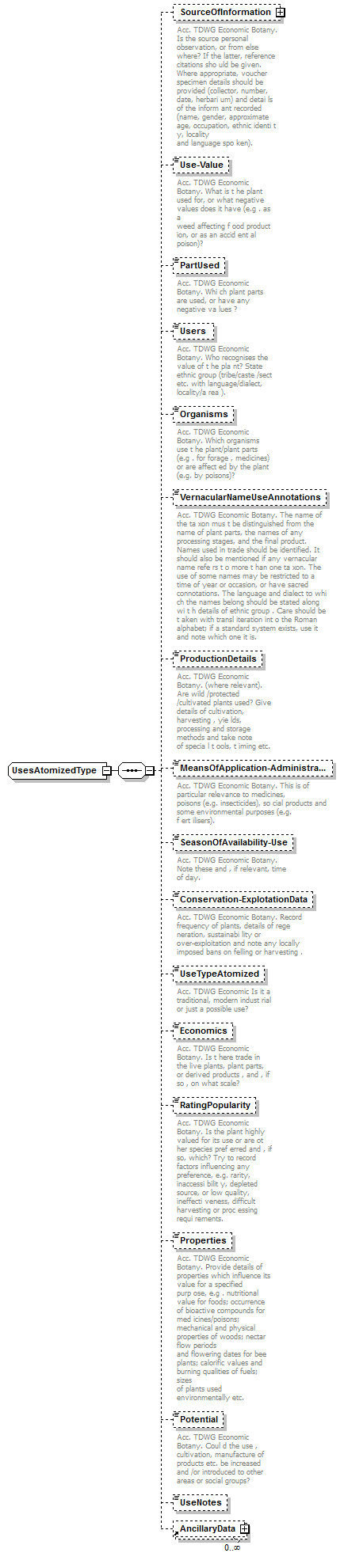
Where does the observation come from? Reference citations should be given. Where appropriate, voucher specimen details should be provided (collector, number, date, herbarium) as well as details of the recorded informant (name, gender, approximate age, occupation, ethnic identity, locality and spoken language).
Reference: Acc. TDWG Economic Botany
Used to refer the sources.
Quick reference: tcs: ReferenceType
What is the plant used for, or what negative values does it have
e.g. weeds affecting food production, poisons, environmental uses,...
Reference: Acc. TDWG Economic Botany
Class: NormalString
Specific plant parts used
e.g. Entire plant, galls, seeds, bark,...
Reference: Acc. TDWG Economic Botany
Class: NormalString
Acc. TDWG Economic Botany. The one who recognizes the value and/or use of the plant.
e.g. State ethnic group (tribe/caste /sect, etc.) with a language/dialect, in a locality/area.
Class: NormalString
Acc. TDWG Economic Botany. Organisms which use the plant/plant parts (e.g . for forage , medicines) or are affected by the plant (e.g. by poisons)
e.g. Birds, mammals, bacteria,...
Class: NormalString
Acc. TDWG Economic Botany. The name of the taxon must be distinguished from the name of theplant parts, the names of any processing stages, and the final product name. Names used in trade should be identified. It should also be mentioned if any vernacular name refers to more than one taxon. The use of some names may be restricted to a time of year or occasion, or have sacred connotations. The language or dialect to which the names belong should be stated along with details of the ethnic group. Care should be taken with transliteration into the Roman alphabet; if a standard system exists, use it and note which one it is.
Class: NormalString
TAcc. TDWG Economic Botany. (where relevant). Give details of protection, cultivation, harvesting, yields, processing and storage methods used and take note of special tools, timing etc.
Class: NormalString
Acc. TDWG Economic Botany. This is particulary relevant for medicines, poisons (e.g. insecticides), social drugs and some environmental purposes (e.g. fertilisers).
Class: NormalString
Acc. TDWG Economic Botany. Note these and , if relevant, time of day.
Class: NormalString
Acc. TDWG Economic Botany. Record frequency of plants, details of rege neration, sustainabi lity or over-exploitation and note any locally imposed bans on felling or harvesting.
Class: NormalString
Acc. TDWG Economic Is it a traditional, modern indust rial or just a possible use?
Class: NormalString
Acc. TDWG Economic Botany. Is t here trade in the live plants, plant parts, or derived products , and , if so , on what scale?
Class: NormalString
Acc. TDWG Economic Botany. Is the plant highly valued for its use or are ot her species pref erred and , if so, which? Try to record factors influencing any preference, e.g. rarity, inaccessi bilit y, depleted source, or low quality, ineffecti veness, difficult harvesting or proc essing requi rements.
Class: NormalString
Acc. TDWG Economic Botany. Provide details of properties which influence its value for a specified purp ose, e.g . nutritional value for foods; occurrence of bioactive compounds for med icines/poisons; mechanical and physical properties of woods; nectar flow periods and flowering dates for bee plants; calorific values and burning qualities of fuels; sizes of plants used environmentally etc.
Class: NormalString
Acc. TDWG Economic Botany. Coul d the use , cultivation, manufacture of products etc. be increased and /or introduced to other areas or social groups?
Class: NormalString
Class: NormalString
Ancillary information for each UsesAtomized element.
Class: [AncillaryDataClass] (https://github.com/PlinianCore/Documentation/wiki/AncillaryDataClass)
| Image | Description |
|---|---|
|
Complex Type |
|
Sequence structure |
 |
Choice structure |
 |
Obligatory element |
 |
Optional element |
 |
minOccurs=0 maxOccurs=unbounded |
 |
minOccurs=1 maxOccurs=unbounded |