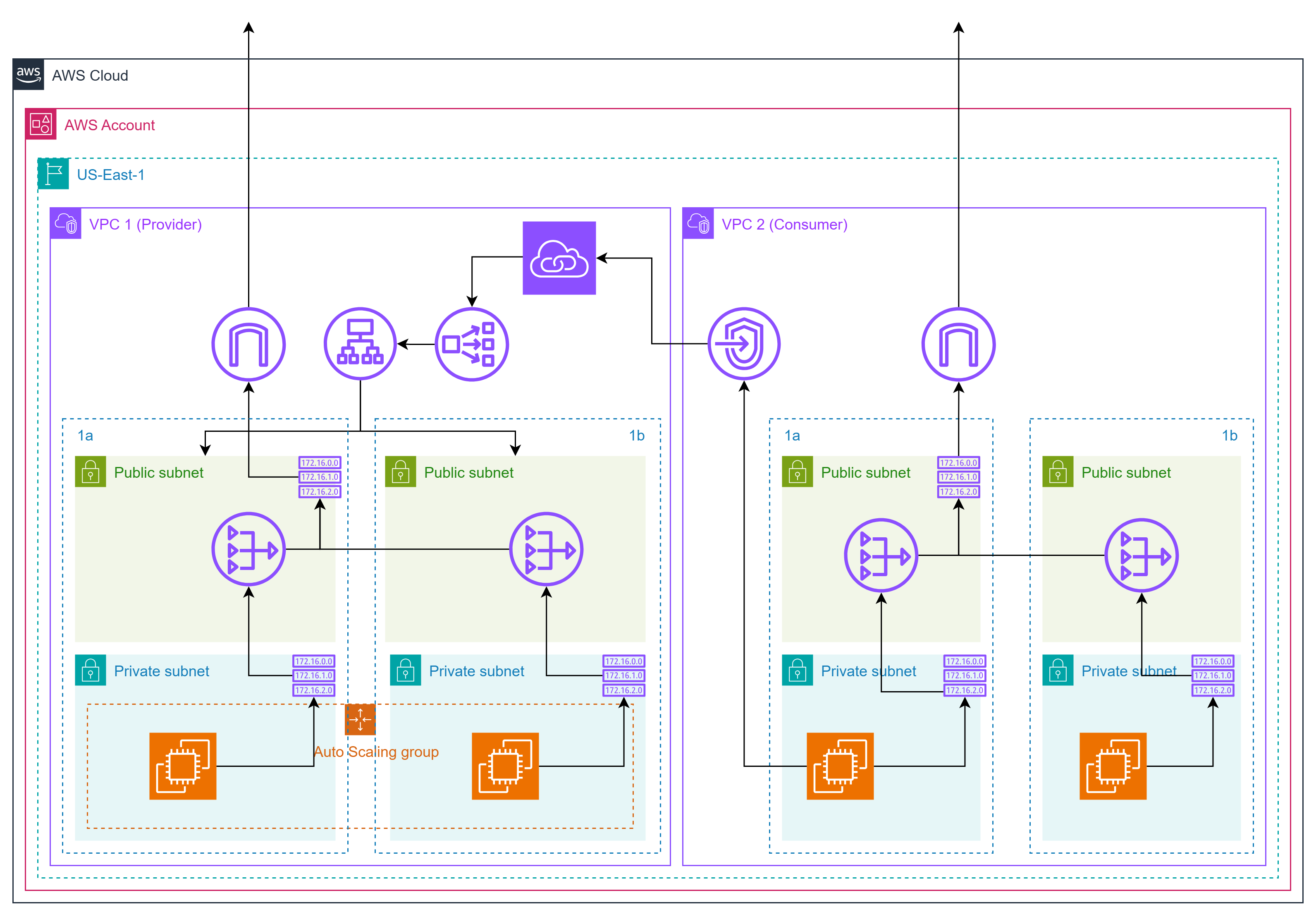
This Terraform project implements a PrivateLink architecture between two isolated AWS VPCs using modular design:
- VPC1 (Provider) hosts an internal service behind an NLB (Network Load Balancer) exposed via a VPC Endpoint Service.
- VPC2 (Consumer) connects privately to that service through an Interface VPC Endpoint, retrieving the service name automatically via AWS Systems Manager (SSM) Parameter Store.
Both VPCs follow the same modular structure:
vpc1/
 ├── modules/
 │   ├── network/
 │   │      ├── igw.tf
 │   │      ├── ngw.tf
 │   │      ├── output.tf
 │   │      ├── private.tf
 │   │      ├── public.tf
 │   │      ├── region.tf
 │   │      ├── service-ssm-parameter
 │   │      ├── variables.tf
 │   │      ├── vpc.tf
 │   │      └── vpce-service.tf
 │   └── compute/
 │          ├── alb-sg.tf
 │          ├── alb.tf
 │          ├── output.tf
 │          ├── asg-sg.tf
 │          ├── asg.tf
 │          ├── nlb.tf
 │          ├── userdata.sh
 │          └── variables.tf
 ├── locals.tf
 ├── modules.tf
 ├── provider.tf
 └── variables.tf

vpc2/
 ├── modules/
 │   ├── network/
 │   │      ├── igw.tf
 │   │      ├── ngw.tf
 │   │      ├── output.tf
 │   │      ├── private.tf
 │   │      ├── public.tf
 │   │      ├── region.tf
 │   │      ├── variables.tf
 │   │      ├── vpc.tf
 │   │      ├── vpce-sg.tf
 │   │      └── vpce.tf
 │   └── compute/
 │          ├── ec2.tf
 │          ├── instance-profile.tf
 │          └── variables.tf
 ├── locals.tf
 ├── modules.tf
 ├── provider.tf
 └── variables.tf
| Step | Action | Directory | Description |
|---|---|---|---|
| 1️⃣ | Initialize and deploy VPC1 | vpc1/ |
Creates provider VPC, subnets, NAT, ALB, NLB, ASG, and publishes the PrivateLink service to SSM |
| 2️⃣ | Initialize and deploy VPC2 | vpc2/ |
Creates consumer VPC, subnets, NAT, EC2 instance with SSM, and connects to the PrivateLink |
| 3️⃣ | Verify connection | AWS Console / CLI | Test EC2 instance communication via PrivateLink |
| 4️⃣ | (Optional) Destroy | Each VPC folder | Safely remove all resources |
git clone https://github.com/gossilva/aws-privatelink-terraform.git
cd aws-privatelink-terraformcd vpc1
terraform init
terraform plan
terraform apply -auto-approveAfter VPC1 is successfully applied:
cd ../vpc2
terraform init
terraform plan
terraform apply -auto-approve
⚠️ Ensure both VPCs are in the same AWS Region (default:us-east-1).
cd vpc2 && terraform destroy -auto-approve
cd ../vpc1 && terraform destroy -auto-approveEach VPC uses its own locals.tf for consistent tagging:
locals {
  tags = {
    Department    = "Networking"
    Organization  = "Infrastructure and Operations"
    Project       = "PrivateLink"
    Environment   = "Development"
  }
}locals {
tags = {
Department = "Fintech"
Organization = "Finances and Marketplace"
Project = "Banking Application"
Environment = "Production"
}
}These tags propagate automatically to all resources via local.tags.
Each VPC is designed to support separate remote states (for scalability and modular independence).
Example (currently commented in provider.tf):
backend "s3" {
  bucket = "vpc1-state"
  key    = "path/to/vpc1"
  region = "us-east-1"
}
and
backend "s3" {
  bucket = "vpc2-state"
  key    = "path/to/vpc2"
  region = "us-east-1"
}Creates VPC1’s core infrastructure:
- VPC, subnets, route tables, IGW, NAT
- Public & Private subnets across AZs
- PrivateLink VPC Endpoint Service with NLB
- Stores service name in SSM Parameter Store
Creates application layer:
- ALB + ASG (with Launch Template)
- NLB for PrivateLink exposure
- EC2 UserData startup script (
userdata.sh) - Security Groups for both ALB and ASG
Creates client-side VPC:
- VPC, subnets, IGW, NAT, route tables
- Interface VPC Endpoint connecting to VPC1’s service via SSM
Creates EC2 instance with IAM role and SSM access:
- EC2 with
AmazonSSMManagedInstanceCore - Instance Profile with minimal trust policy
- Allows remote management via AWS Systems Manager
✅ Modular and reusable Terraform structure ✅ Multi-VPC design using PrivateLink ✅ Automatic cross-VPC connection via SSM Parameter Store ✅ Full tagging standardization with locals ✅ Easily extensible to multi-region or multi-account setups
# Deploy Provider VPC
cd vpc1
terraform init && terraform apply -auto-approve

# Deploy Consumer VPC
cd ../vpc2
terraform init && terraform apply -auto-approveMIT License — freely reusable and modifiable for educational or production environments.