A lightweight error log collection and analysis web application written in Go, designed to centrally manage error logs from multiple PHP projects (other projects are fine too, but most of mine are PHP, so that's why I say it this way) and leverage DeepSeek to help you quickly pinpoint issues.
Detect and resolve problems before your clients even notice.
This project has been parsed by Zread. If you need a quick overview of the project, you can click here to view it:Understand this project
As someone maintaining multiple PHP projects, you may have experienced these frustrations:
- Issues only become apparent after client feedback, making you reactive rather than proactive;
- When everything seems fine, it’s hard to proactively check through all logs.
This is why I created oh-shit-logger.
It aggregates all your project’s critical errors on a single page, organizes them by date, supports pagination, and can automatically analyze error information using DeepSeek to provide possible solutions.
By deploying it on your own server (or a company machine), all PHP project error logs can be reported in real time.
This way, even before the client speaks up, you already know: "Oh, something went wrong."
| List | Details |
|---|---|
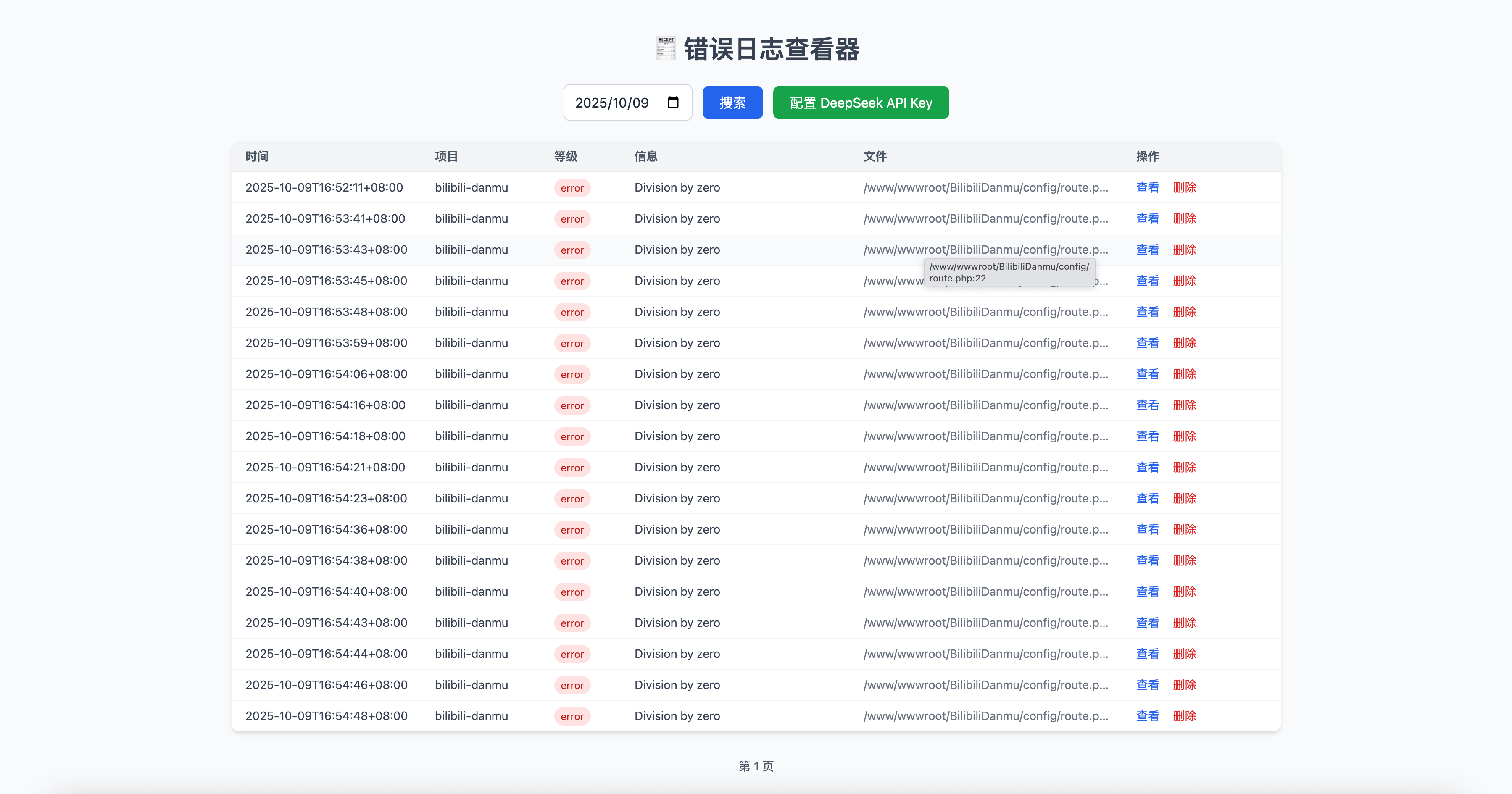 |
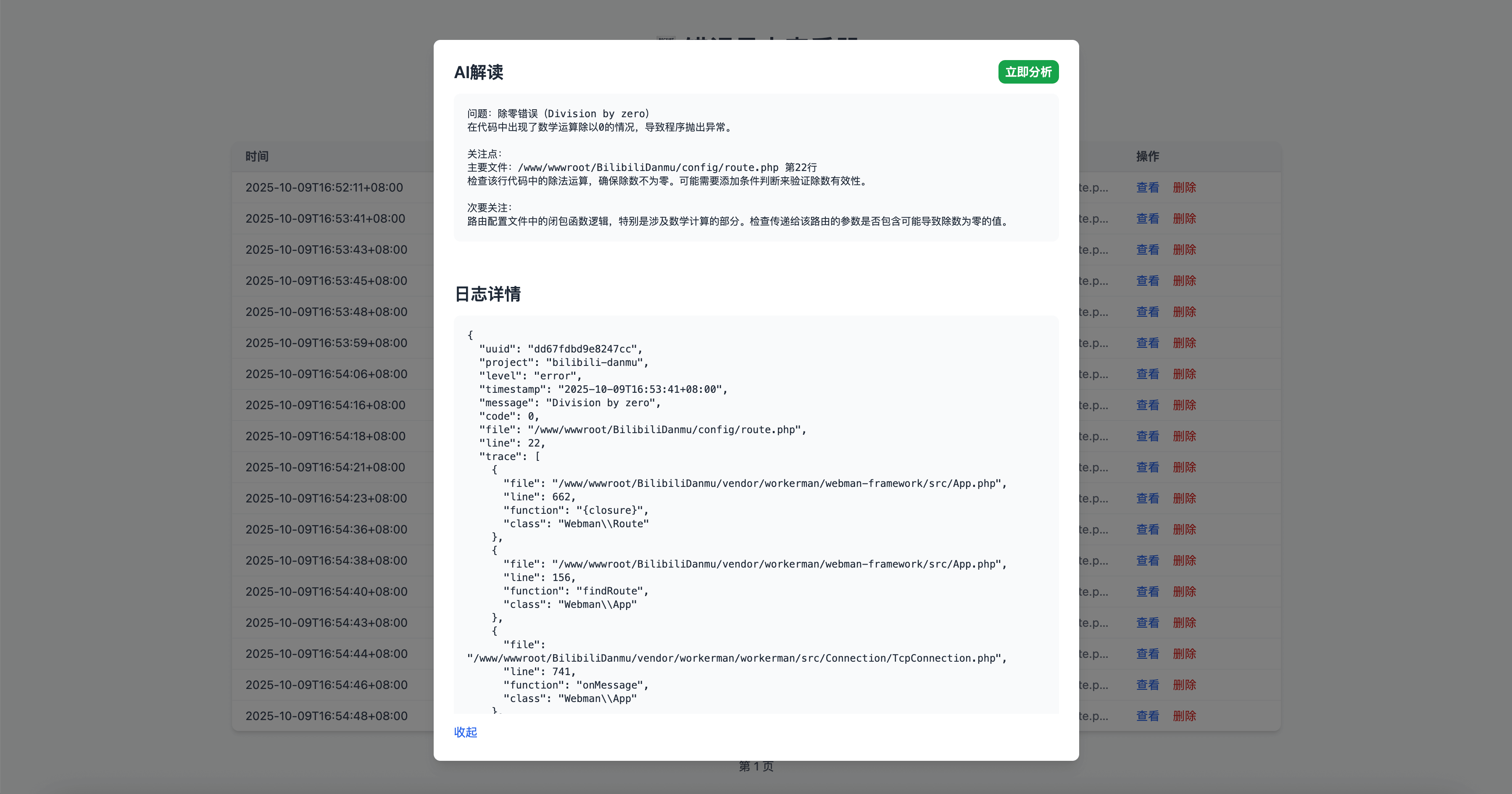 |
Download the latest release from Releases, extract it, and run:
chmod +x ./app
./app -port=9999 -retain=7 -user=admin -pass=123123
Available parameters:
| Parameter | Description | Default |
|---|---|---|
port |
Port number to run the server | 9999 |
retain |
Number of days to retain logs | 7 |
user |
BasicAuth username (recommended) | - |
pass |
BasicAuth password (recommended) | - |
If both
userandpassare not provided, BasicAuth will be disabled. It’s not recommended to disable authentication to prevent unauthorized access to error logs.
After starting, access:
👉 http://YOUR_SERVER_IP:PORT/read
to view error logs.
Clone the project to your local machine or server:
git clone https://github.com/zxc7563598/oh-shit-logger.git ./oh-shit-loggerBuild the project:
cd oh-shit-logger
go build -o ./app main.go
Run the project (same as above):
./app -port=9999Access
http://YOUR_SERVER_IP:PORT/readto see the error list.
In your project’s exception handling logic, format errors into a unified structure and report them:
Place this in your central exception handler, regardless of framework.
/**
 * Format a Throwable as a standard JSON string
 * POST the data to your server’s /write endpoint, e.g.: http://YOUR_SERVER_IP:PORT/write
 *
 * @param Throwable $e Error object
 * @param array $context Optional contextual information to help locate issues
 */
function formatThrowable(Throwable $e, array $context = []): string
{
    $trace = array_map(static function ($t) {
        return [
            'file'     => $t['file'] ?? null,
            'line'     => $t['line'] ?? null,
            'function' => $t['function'] ?? null,
            'class'    => $t['class'] ?? null,
        ];
    }, $e->getTrace() ?? []);

    $data = [
        'uuid'      => bin2hex(random_bytes(8)),
        'project'   => 'project', // Your project name
        'level'     => 'error',
        'timestamp' => date('c'),
        'message'   => $e->getMessage(),
        'code'      => $e->getCode(),
        'file'      => $e->getFile(),
        'line'      => $e->getLine(),
        'trace'     => $trace,
        'context'   => (object)$context,
        'server'    => [
            'hostname'    => gethostname() ?: 'unknown',
            'ip'          => $_SERVER['SERVER_ADDR'] ?? '127.0.0.1',
            'php_version' => PHP_VERSION,
        ],
    ];
    return json_encode($data, JSON_UNESCAPED_UNICODE | JSON_UNESCAPED_SLASHES);
}

// Report the error to oh-shit-logger
$ch = curl_init();
curl_setopt($ch, CURLOPT_URL, 'http://YOUR_SERVER_IP:PORT/write');
curl_setopt($ch, CURLOPT_POST, true);
curl_setopt($ch, CURLOPT_RETURNTRANSFER, true);
curl_setopt($ch, CURLOPT_POSTFIELDS, formatThrowable($exception, [
    'module' => 'user-center',
    'action' => 'login',
]));
curl_exec($ch);
curl_close($ch);
It is recommended to report only fatal or unrecoverable exceptions, or focus on critical errors to avoid log overload.
Visit http://YOUR_SERVER_IP:PORT/read
to view all reported error logs.
- Automatically categorized by date
- Supports pagination
- Built-in DeepSeek analysis for one-click issue insights
Feel free to submit issues or feature requests via Issues.
If this project helps you, please don’t forget to ⭐️ Star to show your support!