


A simple, educational package for fine-tuning Vision Transformer (ViT) models using PyTorch. Achieves 97.65% accuracy on CIFAR-10 with modern training techniques.
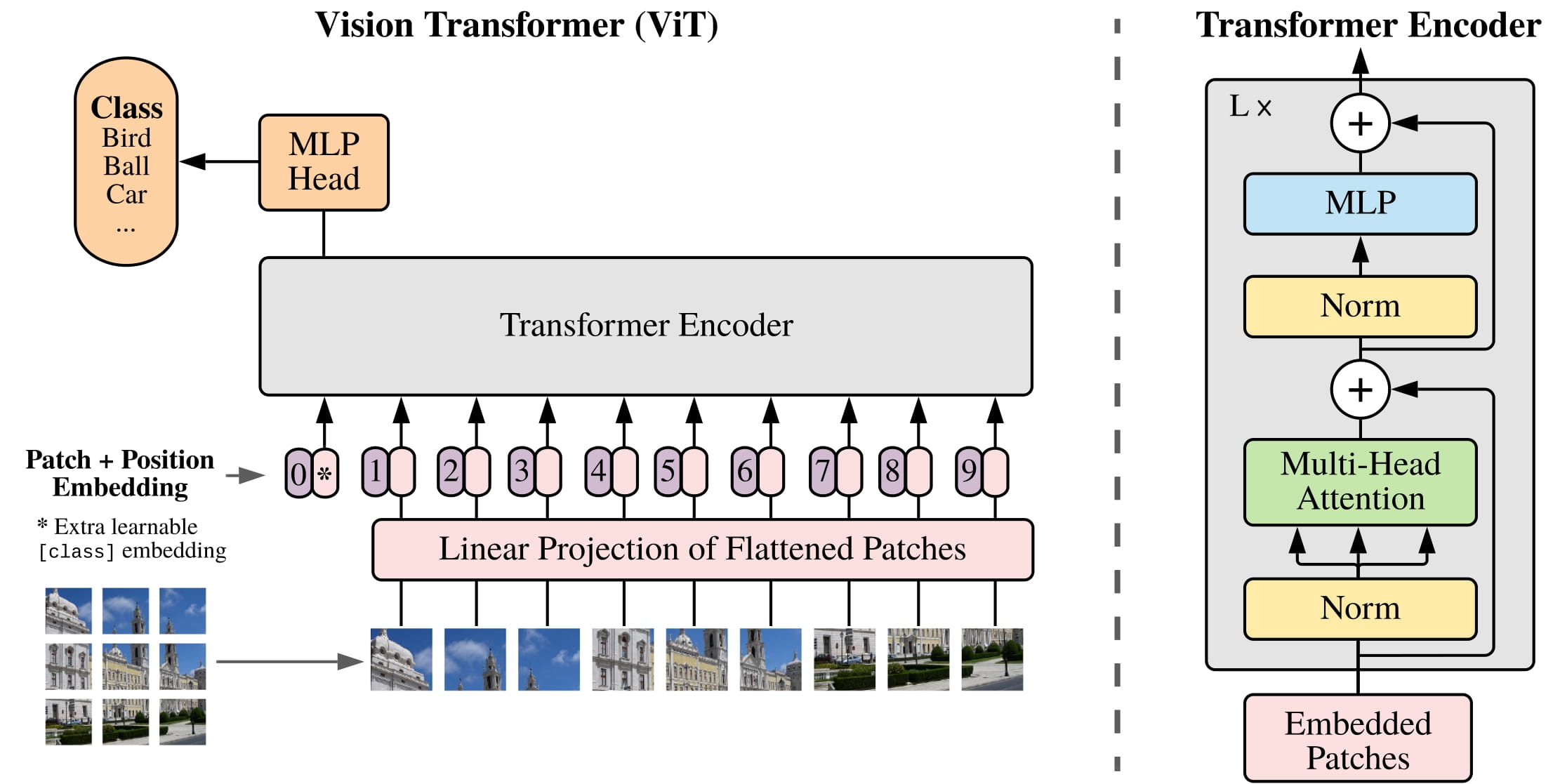
| vs. timm/transformers | vit-trainer |
|---|---|
| 1000+ model architectures | Focused on ViT fine-tuning |
| Complex APIs | Simple, readable code |
| Research-oriented | Educational + Production ready |
Features:
- Mixed precision training (AMP) for 2-3x speedup
- AdamW optimizer with cosine annealing + warmup
- Attention visualization for interpretability
- ONNX export for deployment
- CLI and Python API
pip install vit-trainer# Gradio web demo
pip install "vit-trainer[demo]"
# ONNX export
pip install "vit-trainer[export]"
# Everything
pip install "vit-trainer[all]"git clone https://github.com/jman4162/PyTorch-Vision-Transformers-ViT.git
cd PyTorch-Vision-Transformers-ViT
pip install -e ".[dev]"from vit_trainer import Trainer, load_model, get_cifar10_loaders
# Load data and model
train_loader, val_loader, test_loader = get_cifar10_loaders(batch_size=64)
model = load_model("vit_b_16", num_classes=10)
# Train
trainer = Trainer(model, lr=1e-4, use_amp=True)
history = trainer.fit(train_loader, val_loader, epochs=10)
# Evaluate
loss, accuracy = trainer.evaluate(test_loader)
print(f"Test Accuracy: {accuracy:.2f}%")# Train a model
vit-train train --model vit_b_16 --dataset cifar10 --epochs 10
# Evaluate a trained model
vit-train eval --checkpoint best_model.pt --dataset cifar10 --plot-confusion
# Predict on a single image
vit-train predict --checkpoint best_model.pt --image cat.jpg --show-attention
# Export to ONNX
vit-train export --checkpoint best_model.pt --output model.onnx# Use YAML config
vit-train train --config configs/default.yamlfrom vit_trainer import Trainer, load_model, get_cifar10_loaders, TrainingConfig
# Create config
config = TrainingConfig(
model_variant="vit_b_16",
batch_size=64,
epochs=10,
lr=1e-4,
weight_decay=0.05,
warmup_epochs=2,
patience=3,
use_amp=True,
)
# Train
train_loader, val_loader, _ = get_cifar10_loaders(batch_size=config.batch_size)
model = load_model(config.model_variant, num_classes=10)
trainer = Trainer(
model,
lr=config.lr,
weight_decay=config.weight_decay,
warmup_epochs=config.warmup_epochs,
use_amp=config.use_amp,
)
trainer.fit(train_loader, val_loader, epochs=config.epochs, patience=config.patience)from vit_trainer import visualize_samples_with_attention, CIFAR10_CLASSES
visualize_samples_with_attention(
model,
test_loader.dataset,
CIFAR10_CLASSES,
num_samples=4,
)from vit_trainer import get_predictions, compute_metrics, plot_confusion_matrix
y_pred, y_true, probs = get_predictions(model, test_loader)
metrics = compute_metrics(y_true, y_pred, CIFAR10_CLASSES)
print(metrics["classification_report"])
plot_confusion_matrix(y_true, y_pred, CIFAR10_CLASSES)from vit_trainer import load_model
# Load from checkpoint
model = load_model(
"vit_b_16",
num_classes=10,
checkpoint_path="best_model.pt",
)from vit_trainer import load_model, ExportConfig
# Load trained model
model = load_model("vit_b_16", num_classes=10, checkpoint_path="best_model.pt")
# Export to ONNX
config = ExportConfig(output_path="model.onnx", opset_version=14)
config.export(model)
# Or use CLI
# vit-train export --checkpoint best_model.pt --output model.onnxfrom vit_trainer import (
# Configuration
TrainingConfig, # Training hyperparameters
ExportConfig, # ONNX export settings
# Models
load_model, # Load ViT with pretrained weights
VIT_VARIANTS, # Available model variants
# Data
get_cifar10_loaders, # CIFAR-10 data loaders
get_cifar100_loaders, # CIFAR-100 data loaders
CIFAR10_CLASSES, # Class names
# Training
Trainer, # Training loop with AMP
EarlyStopping, # Early stopping callback
ModelCheckpoint, # Save best model
# Evaluation
evaluate_model, # Loss and accuracy
compute_metrics, # Precision, recall, F1
plot_confusion_matrix, # Visualization
# Visualization
visualize_attention, # Attention heatmaps
)vit-trainer/
├── vit_trainer/
│ ├── __init__.py # Public API
│ ├── config.py # TrainingConfig dataclass
│ ├── cli.py # Command-line interface
│ ├── data/ # Data loaders and transforms
│ ├── models/ # Model registry and factory
│ ├── training/ # Trainer and callbacks
│ ├── evaluation/ # Metrics and plotting
│ └── visualization/ # Attention maps
├── tests/ # Unit tests (44 tests)
├── configs/ # YAML configurations
├── notebooks/ # Tutorial notebooks
├── app.py # Gradio demo
└── pyproject.toml # Package configuration
| Variant | Patch Size | Parameters | ImageNet Acc | Use Case |
|---|---|---|---|---|
vit_b_16 |
16x16 | 86M | 81.1% | Best accuracy/speed |
vit_b_32 |
32x32 | 88M | 75.9% | Faster inference |
vit_l_16 |
16x16 | 304M | 79.7% | Higher accuracy |
| Metric | Value |
|---|---|
| Test Accuracy | 97.65% |
| Model | vit_b_16 |
| Training Time | ~11 min/epoch (GPU) |
# Launch interactive web interface
python app.py
# Opens at http://localhost:7860# Install dev dependencies
pip install -e ".[dev]"
# Run tests
pytest tests/
# Format code
black vit_trainer/
ruff check vit_trainer/
# Type check
mypy vit_trainer/- Reduce batch size:
--batch-size 32or16 - AMP is enabled by default
- Use Google Colab (free GPU)
- Training on CPU is very slow (~60 min/epoch)
- Make sure to install the package:
pip install vit-trainer
Contributions are welcome! Please feel free to submit a Pull Request.
Distributed under the MIT License. See LICENSE for more information.